InsightsJuly 23, 2026, 7 min read
AI observability: the missing layer between AI demos and production systems
AI observability helps engineering leaders understand how AI systems behave in production, where they fail, what they cost, and when teams need to step in.
By GILD

Most AI demos work.
That was never the hard part.
The harder question is what happens six months later, when the same system is running in production, handling real customers, and nobody can say with confidence why it did what it did.
That is the gap technical leaders are running into right now.
Not “does the model work?” But “do we actually know what it is doing?”
AI observability is becoming the answer. And for engineering leaders moving AI from proof of concept to production, it is quickly turning into one of the more important operating decisions on the table.
Most AI demos work. The harder question is whether the system can be trusted once it is live.
What is AI observability?
AI observability is the visibility layer that tells you how an AI system behaves once it is live.
It covers whether the system is running and producing reliable, explainable, and usable outcomes in the real world.
That means understanding what context a model used, what it output, what it cost, how its behavior changed over time, and where a human needs to step in before something breaks trust with a customer.
This is different from traditional uptime monitoring.
A system can be up, fast, and still be wrong. Observability is what catches that.
Why LLM observability is becoming core infrastructure
LLM observability is the layer of AI observability built specifically for language model systems.
It looks at prompts, completions, retrieval quality, hallucination risk, semantic drift, relevance, latency, and cost. It answers a different question than traditional application monitoring.
Not just, “Did the call succeed?” But, “Was the output good enough to trust?”
That distinction matters more as AI systems move closer to real business workflows. In a demo, a weak answer is easy to explain away. In production, a weak answer can affect a customer, trigger the wrong workflow, mislead a user, or create downstream risk before anyone notices.
So the market is moving LLM observability from a nice-to-have debugging layer to core infrastructure.
The exact tools will keep changing. The underlying need will not. Once AI becomes part of the product, teams need a way to see what it is doing.
What should AI observability tools actually track?
For technical leaders, the practical bar for AI observability tools has moved past dashboards.
A useful AI observability layer should help teams understand performance, quality, cost, and risk in the same operating view.
That usually means tracking:
Token-level cost, so teams can see spend by app, team, model, or agent
Output quality, so hallucinations, relevance, and factual accuracy are measured consistently
Prompt and context traces, so teams can understand what the model saw before producing an answer
Drift across prompts, users, and use cases, so quality degradation is caught early
Human feedback loops, so production issues influence what gets improved next
The point is to watch AI behave and judge whether that behavior is good enough for the system to keep running, scaling, or automating more of the workflow.
That is where observability becomes an engineering leadership question that includes tooling.
Why AI monitoring alone is not enough
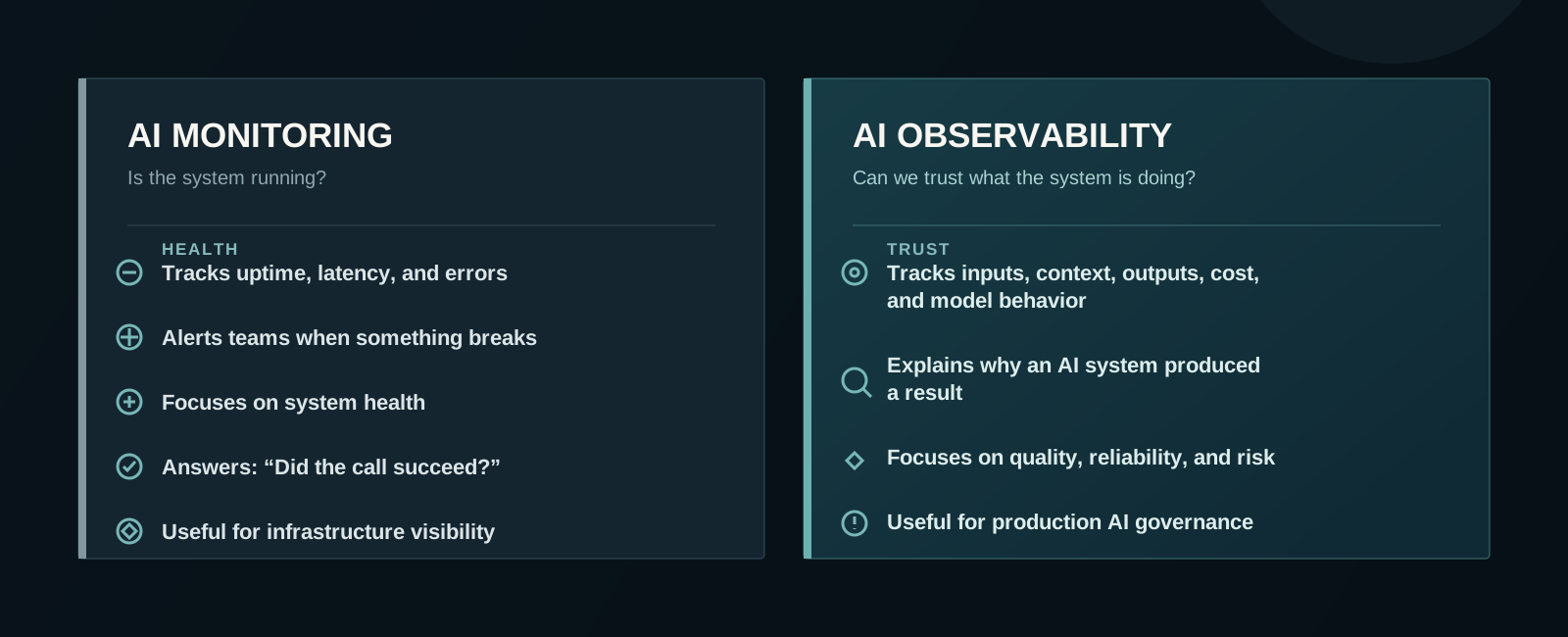
AI monitoring and AI observability often get used interchangeably, but they are not the same job.
Monitoring tells you whether the system is running. Observability helps explain what the system is doing and why.
That difference becomes more important as companies move from single-model experiments to multi-step AI workflows or agentic systems. In those environments, one weak output can cascade across several handoffs before a human ever sees it.
A model can retrieve the wrong context. Another system can act on that output. A workflow can move forward with false confidence. By the time the issue shows up, the root cause may be hard to trace.
AI teams need uptime checks and visibility into the chain of decisions, inputs, outputs, costs, and handoffs that produced the result.
Without that layer, production AI becomes difficult to govern and harder to trust.
Monitoring vs. observability
The real question for technical leaders
The real question underneath AI observability is not, “Which tool should we buy?” It is, “What level of confidence do we need before this system can safely scale?”
That is a leadership decision.
It touches engineering, product, security, compliance, customer experience, and budget. It also forces teams to define what “good enough” means for AI output, which goes beyond whether the system is technically functioning.
For some use cases, a human-in-the-loop workflow may be enough. For others, teams may need stricter evaluation, better tracing, clearer escalation paths, or tighter controls around what the AI system is allowed to do.
AI observability is becoming the trust layer for production AI.
Not a nice-to-have for debugging. Not just another dashboard. But the layer that lets technical leaders say, with more confidence, that the system can be measured, governed, improved, and scaled.
AI observability should tell you more than whether an agent is technically working.
It should show whether the system is using the right company data, following the right sales and marketing workflows, reaching the right accounts, and contributing to qualified leads, pipeline, and revenue.
Tecla Labs builds those requirements into the system from the start.
Their engineers connect the system to the company’s data, tools, and workflows. Their growth experts stay in the loop to review outputs, handle exceptions, measure performance, and keep improving the results.
The goal isn’t just to see what the AI did. It’s to know whether it’s generating measurable ROI.
Tecla Labs builds and runs AI systems designed to generate leads, pipeline, and revenue.
Learn more at www.teclalabs.com.
Disclosure: Tecla Labs and GILD share a founder, Gino Ferrand.
Request a seat at an upcoming GILD AI Forum
GILD AI Forums bring senior AI and engineering leaders together for candid, off-the-record conversations about what is actually working inside companies, what is breaking, and how technical teams are adapting in real time.
If this is the kind of conversation you are navigating inside your own team, request a seat at an upcoming GILD AI Forum.
Request a seat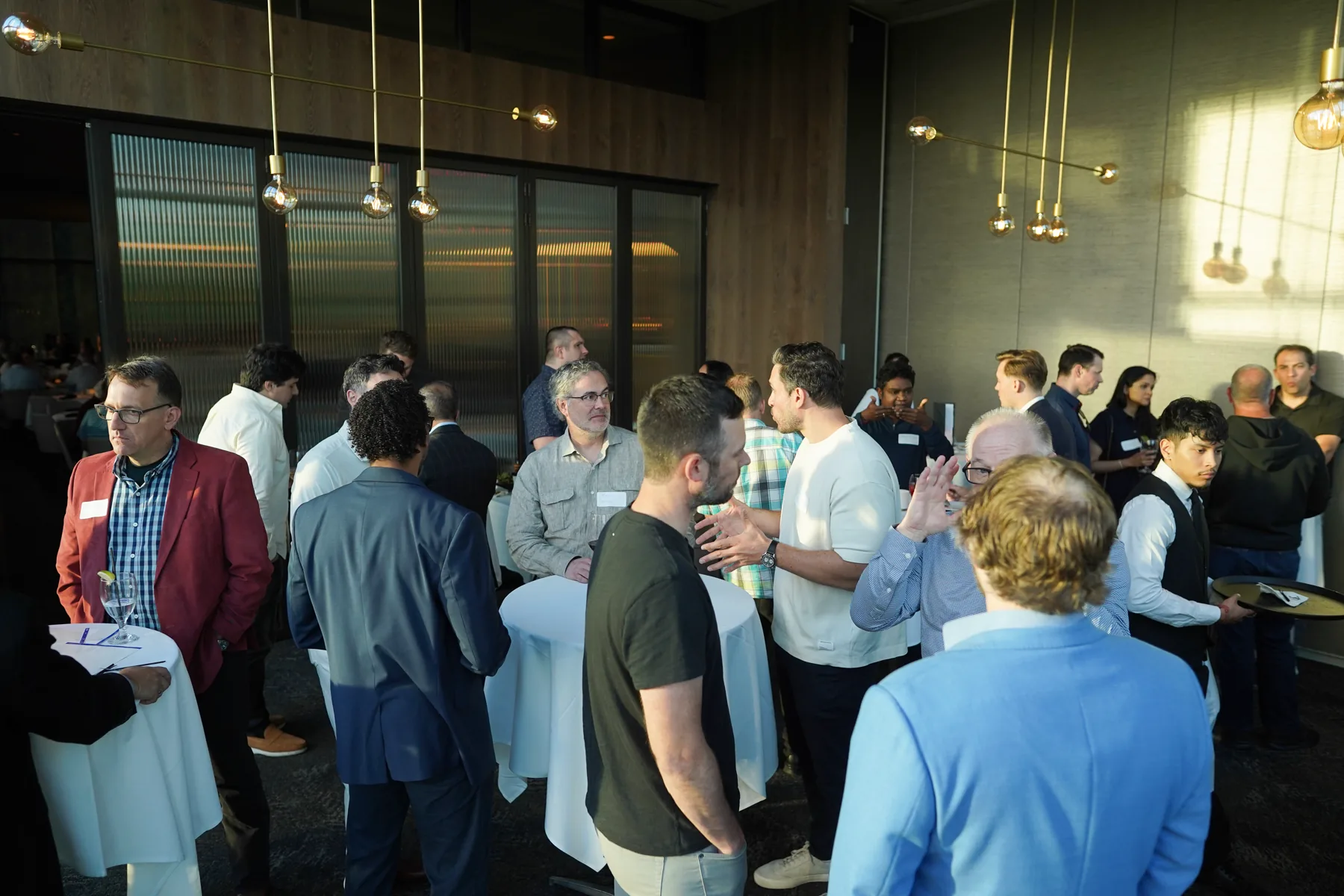
GILD, July 23, 2026